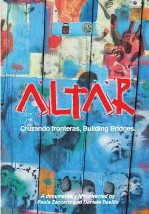
A SONG OF THANK YOU:
TO ALL THE CO-MADRES IN THIS MOVIE:
IN THE BEGINNING, IRENE RETI AND:
LILIANA WILSON
SANTA BARRAZA
CYNTHIA PEREZ
GRACIELA SANCHEZ
GLORIA RAMIREZ
AMALIA-MESA BAINS
BETITA MARTINEZ
JUANA ALICIA
ANTONIA CASTAÑEDA
ANALOUISE KEATING
Jamie Anzaldua
THE INVISIBLE CO-MADRES:
Lina Suarez
Kamala Platt
Amanda Haas
And many thanks to:
Norma Cantu
Analouise Keating
Olga Herrera
TO THE MEN WHO HELPED ME IN THIS JOURNEY:
DANIEL GARCIA ORDAZ, THE POET MARIACHI BORDER GUIDE
LUIS GUEVERA, THE MAN WHO WITHOUT KNOWING ME, GAVE HIS ID SO THAT I COULD RECEIVE THE MEDICINES FROM ITALY stopped at the US borders
CHRISTIAN KELLEHER, THE PRECIOUS ARCHIVIST
DANIELE BASILIO, THE FILMAKER WHO TUNED HIS EMOTIONS with THE ALMOST ALL-WOMEN CAST OF HIS MOTHER’S MUCH DESIDERED MOVIE.
VICTOR CARTAGENA AND HIS FANTASTIC “THE INVISIBLE NATION”.
Some of you can ask why Gloria's voice and body is not more present. Actually her "absence" was meant. I did
not want to document her bi(bli)ography, but her legacy, i.e.
what she passed on to others and what she received from her community,
co-madres and contemporary women artists.I wanted the
"receivers" to narrate what she donated.
At the beginning I thought I would not even use the clips of archive footage. I later inserted, because I wanted the audiece
to FEEL her absence. Perhaps the result does not fulfill the intention;
perhaps I have failed.
But the central idea was to have a sort of visual version of a choral narrative on her,
something to help fight the holes in memory which often
take place in this age so speedy in eradicating visions and thinking.
When i started thinking of a movie on GEA’S legacy, I had two elements at the
basis of my germinal intuition that visuality was central in her work and
life and that she, or better her visionary and at the same time material
vision, surely had been a great source of inspiration for chicana artists:
- the section in Borderlands/La Frontera entitled “Tlilli, Tlapally”, where she writes about the creative process: “An image is a bridge between evoked
emotion and conscious knowledge; words are the cables that hold up the
bridge. Images are more direct, more immediate than words, closer to the
unconscious. Picture language precedes thinking in words; the metaphorical
mind precedes analytical consciousness”;
-the unbelievable amount of artworks furnishing her house in SC when I went
to interview her, in 1998: drawings, scketches, paintings, posters, little
sculptures, articrafts where everywhere: you could not sit on the couch
because is was literally clothed with layers of this sort of things; visual
stuff was on the walls, in the bathroom, etc.
So, when I started thinking of a new work on my querida author, I thought this time I
wanted to use a picture language; I wanted a picture language which evoked
emotion and conocimiento; I wanted to translate my experiencing her world, her
thinking, her world in a metaphorical, visual language: “Images are more
direct, more immediate than words, closer to the unconscious.”
But I did not expect the amount of visual material contained in the boxes and folders, 220, at the Benson Library. I did not know, when I started my research, that she had directed a one-month seminar on nepantla, at Villa Montalvo, where her “students” were women artists such as Liliana Wilson and Santa Barraza...
In the future, the most astounding insights in her work, I believe, will come from the visual works, her drawings (1976 and 1987-90), and the scketches she drew for her teaching and gigs.
If you google GEA’s papers, you will find this address:
http://www.lib.utexas.edu/taro/utlac/00189/lac-00189p1.html
In the papers you will find:
Personal and biographical materials, correspondence, written works, research materials, photographs, audiovisual materials,Gigs and Teaching, Phone Logs, Calendars and Address Books, Collected Materials, Oversized Materials and Artifacts, Clippings, buttons. T-shirts and much more...
When I started, the idea was to have a sort of visual version of a biography. Besides, as a teacher I know that visual codification is often more effective and telling than verbal communication in the class.
When I started, I thought it would have been useful for my students, for the students and women of different venues where I go to give talks on my querida GEA, and if the result was quite good I would perhaps dare to present it to a Chicano audience...
This film is my own mestizo altar for Gloria Evangelina Anzaldua, although I am an outsider to Chicano culture, and so I ask forgivance for my misinterpretations.
The other idea at the basis of the movie was to achieve the texture and pattern of the altar through the fluid intertextuality created by different film genres (documentary, biopic, videoart, interview) and the editing built on adjoining juxtapositions or better intermediality practices aimed at creating interrelations or at least intersections of the different media used (actual shooting, photography, archive footage, archival artifacts...).
WHY TO HAVE A FILM ON GEA?
Because she has become a sort of icon of interlanguage, interculturality, new mestizaje.
Because she can offer a pattern of co-existence and commonality to contemporary societies all over the world struggling to find a way to manage migration, diaspora, cultural and gender difference.
Because she is inspiring, unconventional, other than the commercial writer and yet read in many languages and different cultures.
Because a film shot when there is still her aura around places she lived in, in the memory of people who knew her, in the things she created and touched, is a way to contribute to the salvage of positive female thinking in the XX Century.
Her mythopoetic images – borderlands, thresholds, crossings, bridges, passages, nepantla, etc. – have become the visual core of the movie.
Researching, shooting and editing the movie has been, for me, a nepantla process, a journey leading to subsequent stations in my awareness, a path into conocimiento, to quote our querida forebearer, not only because each single step in knowledge acquired through the consultation of her papers kept me intellectually and emotionally on the move; not only because each single woman and man I encountered through her (in the sense that I first encountered names or photos or crafts by Liliana Wilson, Santa Barraza, Graciela Sanchez, and all the others I will never stop thanking for their generosity, and then encountered and interviewed them physically) left me with a wealth of knowledge and understanding into Gloria’s figure and thinking and into Chicano history and culture, and so moved me on; but it opened up consciousness for me: once back home, this bridge created through her/kept widening (for example, Lourdes Perez, the musician who donated her songs as soundtrack entered in the web of contacts later) and deepening (re-visioning tenth of times interviews, clips, single sentences or expressions, the articrafts, Anzaldua’s own creations and the creations inspired to other people by her forerunner’s work pushed me into a wealth of creativity and thoughts).
And her strength, and the strength of people she had put me in touch with, such as Santa Barraza’s intriguing artistic vision, Cynthia Perez’s strong womanist clear vision, and all the other contributors’ strong insights and actions have been keeping me company and injecting hope with their exemplary figur-actions (I think of the gift of being introduced to Betita Martines by Juana Alicia!) that changing the world is possible. SI, SE PUEDE!
CONTACT ZONES
Was my interest in GEA simply an “exotic” attraction?
Was it a way to pay homage to a foreign practice of “female care”?
No, in some subterranean ways the altar spoke to my unconscious conocimiento: until the recent past, let’s say until the beginning of the 1970s, the Southern Mediterranean area I was born in, knew the practice of the ofrenda, used to have the day of the dead, celebrated the past ones with a “staging” which spoke of nostalgia and sadness, but also renewal of joy for the precious deeds passed on by the departed loved ones.
So, my altar to Gloria can be considered:
the indigenization (Friedman) of Chicano mestizo altars in Southern Mediterranean feminist activist pacifist areas;
the return to consciousness of a practice belonging to my popular, low-class, countryside Southern Mediterranean infancy (at NACCS Ybarra-Frausto spoke of “recuerdo+conocimiento”);
and, at the same time, since XXI Century young people I teach to do not know about their past and know even less about Chicano culture, the altar is (a)the transplantation from Mesoamerica of a cultural artistic praxis speaking out care, everlasting affection and strong bond between life and death, (b) the indigenazion of a foreign practice into a soil (Southern Italy) that still has in its grains traces of similar cultural practices and artistic crafts (“recuerdo with descubrimiento”, in Y.-F.’s terms).
Indeed, I have now a clear sight of the link between Chicano feminist queer decolonizing poetics and politics and Southern Mediterranean feminist queer decolonizing poetics and politics: both cultures have certain basic common grounds:
1) they have been colonized and exploited several times;
2) they are set in the borderlands (I live on the borderland between Africa and Eastern countries and fortress Europe);
3) they have witnessed the arrivals and the expulsions of the illegals, aliens (USA), clandestines (Europe);
4) they have gone through discrimination with regards to North (America/Europe) and yet, since we are both inhabitants of the South, we feel rage at and try to resist to xenophobia, racisms, sexual abuse.
That’s what I tell my students, when introducing my class on Chicano visual and literary cultures; that’s why in the first lesson I let them listen to a Southern taranta or pizzica music, helping them to detect the Spanish, Arabic, African traces speaking of our unspoken colonizations and peculiar mestizaje.
And, lastly (as Alfred Arteaga subtly wrote in Cantos, when palimpsestically underwrote Molly Bloom in la Malinche –Dona Marina), as people of Southern Mediterranean living in Southern Italy, that is living in the area which saw the crossing of many forms of colonialization and imperialism, we are linked to Tunisia, Libya, Morocco by the experience of having been colonized by Spain, France and in the past by the so-called “Moors” and the Turks by: it is not by chance that the European most powerful country, England, still rules a small area which is geographically a Southern small corner of Spain, Gibraltar, the passageway between Europe, but also the Middle East, and the Atlantic, that’s to say the threshold towards the two main destinations of colonization: Africa (and as Gilroy stressed, the slavery system) and the Americas. (paola zaccaria)
[ALTAR: Cruzando Fronteras, Building Bridges]
[ALTAR: Film Synopsis]
[ALTAR: Cast List][ALTAR: Questions & Answers with the Director]
[ALTAR: Expanded Presentation by the Director]
[ALTAR: Director's Statement]
[ALTAR: Technical Credits & Music]